Best Time to Climb Mera Peak (6,476m)
| Season | Month | Weather/Trail | Summi Tmp - Day/Night | Crowd level | Verdict |
| Spring | March/May | Stable weather, clear skies, Rhododendrons in bloom, and pre-monsoon clouds can build. | −8°C to −12°C
Night: −15°C to −18°C | Very High (peak season) | Excellent for climbing. |
| Monsoon | June/Aug | Heavy rain, leeches on lower trails, slippery paths, no visibility, landslides, and trail blockage. | 0°C to −5°C
Night: −8°C to −12°C | Very Low or Zero | Avoid - Not Recommended |
| Autumn | Sep/Nov | Most popular season. October delivers one of the best weather conditions and the best views. | −10°C to −15°C
Night: −18°C to −22°C | Very High specially October. | Best Season for Climbing. |
| Winter | Dec/Feb | Getting very popular. Can be extremely cold, with strong winds, and possible whiteout - less crowded. | −20°C to −25°C
Night: −28°C or below | Very Low | For anyone who can tolerate extreme chill - Off Season. |
How Challenging is Mera Peak Climbing? Difficulty and Preparation
Though Mera Peak is considered one of the highest trekking peaks in Nepal, it is still considered a moderately difficult peak. This is simply because of its reasonable technicality as compared to other 6,000-meter peaks in Nepal. However, climbing Mera Peak is not a walk in the park, and it demands careful preparation and a good level of fitness. It is an extreme High-Altitude expedition that demands basic mountaineering skills.
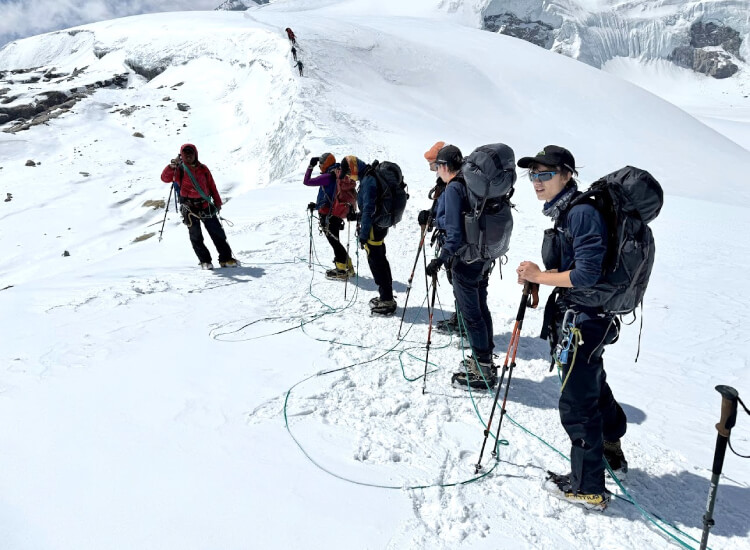
If you are a novice climber, these basic mountain climbing skills can be acquired before the summit, conducted by our professional Climbing Guides. Since climbing Mera Peak requires all the climbing gear like crampons, ice axes, ascenders, descenders, climbing ropes, harnesses, etc, the climber must be acquainted with all these.
Besides, Mera Peak Climbing presents diverse mountain terrain, and climbers must be ready to walk on these different types of mountain terrain, which requires sound physical fitness.
We highly recommend pre-physical training before you sign up for Mera Peak Climbing. To get started, give yourself a few months to get in shape before your expedition. It is not something like you sign up, have a great life in your comfort zone, and eventually fly to Lukla and start your expedition journey.
This trip requires commitment and focus on building your overall physical fitness. We highly suggest getting yourself active with activities like hiking, running, swimming, cycling, and strength training. Pay special attention to cardio that will improve your lung performance and exercises that build leg and core strength. If possible, you can do training that mimics high-altitude conditions.
Most importantly, you need to be ready mentally. A positive attitude is essential, so we always say that mental preparation is just as important as physical training. You are in the wilderness, and it will without doubt test your endurance. Do not give up, but stay healthy.
Don't give up does not mean pushing yourself too much; know your limits, and know if you have any symptoms of AMS. Always make sure that you have the proper equipment and a great expedition team, since it surely heightens the chances of reaching the summit.
As said earlier, Mera Peak is not the most difficult mountain to climb, but it is not a casual walk either. With the right preparation, mindset, and the company you choose, Mera Peak Expedition can be an incredible and rewarding experience.
Acclimatization Tips for Mera Peak Summit
When it comes to climbing any peak in Nepal, ACCLIMATIZATION is absolutely crucial. Similarly, for a successful Mera Peak Expedition, proper acclimatization plays a vital role. As you all know, our body needs time to adapt to high altitude where the level of oxygen is low, and rushing this process can be fatal.
If you rush the process of proper acclimatization, it will surely lead to serious altitude sickness. The golden rule is, climb high, sleep low. This means we are to hike during the day to gain certain elevation, and after being there for a while, we are to get back to a lower elevation for sleeping.
If you look into your itinerary, you will always have REST DAYS. Rest days are not lazy days, they are very crucial and are required for your body to acclimatize at higher altitudes. Make the best use of acclimatization days during your Mera Peak Expedition. Go on a short acclimatization hike and gain a couple of hundred elevation, spend some time there, and return to your camp.
Most significantly, listen to your body. If you have symptoms like headaches, nausea, dizziness, or loss of appetite, don't ignore them. Slow down or take a break, or descend to a lower elevation until the symptoms go off. Do not race, you are here not to compete or to prove how strong you are. Successful summits require patience, attitude at altitude is a dangerous mix.
Check this out for more details on altitude sickness and prevention: Altitude Sickness and Medication and Prevention of High Altitude Sickness.
Daily Hydration is equally important during the process of acclimatization. Since your body loses water much faster at high altitude, it is always very wise to maintain your body with adequate fluid. At least 3-4 liters of water daily is highly recommended. Proper hydration helps your blood carry oxygen more efficiently and further helps in proper acclimatization.
As for the diet, carbohydrates are highly recommended at high altitude for quick energy. Besides, carbohydrates require less oxygen to metabolize. Over the counter, the ACETOZOLAMIDE medicine (popularly known as DIAMOX) is widely used for preventing AMS or mountain sickness.
We have given a list of medicines to carry while trekking or climbing in Nepal. You may check for more details here: Medicine to carry in while trekking or climbing in Nepal:
Finally, communicate openly with your guide about how you are feeling. They are experienced in recognizing altitude sickness and can provide valuable advice or make necessary adjustments to the itinerary.
Safety and Rescue Tips for Mera Peak Summit
When it comes to SAFETY while climbing Mera Peak, it is always our top priority to which we don’t compromise. As it is said, ‘Being well prepared makes a huge difference between a successful climb and a hazardous situation’.
First of all, Nepal Pyramids always makes sure you have an all-inclusive, comprehensive travel insurance that covers high-altitude trekking and emergency helicopter evacuation. So having comprehensive travel insurance is crucial when it comes to climbing Mera Peak.
As we all know, weather conditions in the mountains cannot be predicted as they can change dramatically within minutes. Most of the time in Nepal's mountainous regions it is the weather that can make your vacation into a life-threatening situation. It is always very wise to check the weather forecast or get necessary information from the company you are with so that you can prepare with ease.
Always remember that the mountain isn’t going anywhere, but your life cannot be compromised.
Since the climb to the Mera Peak Summit starts really early in the dark, it is highly recommended to stay in a group. Always be in sight. Speak up immediately if you are unwell, exhausted, or need a helping hand from your local crew.
It is always very wise to take necessary precautions for AMS. Do not skip the rest days and follow the rules and guidelines of your leader for proper acclimatization. You can always take medication like DIAMOX (Acetazolamide) over the counter to prevent Altitude sickness. If you doubt or see any signs of AMS, descend immediately, because descent is the most effective treatment for developing AMS.
Having small but very essential safety equipment while climbing Mera Peak is life-saving. For example, carry a good quality headlamp with fresh batteries and a whistle to signal for help in cases of utter emergencies. Furthermore, keep your mobile phone fully charged, though network coverage can be unreliable, it can be lifesaving if emergency communication is needed.
Understanding the rescue process in emergencies is crucial during the Mera Peak Expedition. In case of emergencies or any casualties, Helicopter evacuation is only possible from Mera Peak Base Camp. But what if you are higher than Mera Base Camp? Your guide will be trained in basic first aid and altitude sickness management, but he will seriously require your assistance.
During this time of crisis, stay together, give emotional first aid to the victim, and help him get to a safer place for the rescue.
The BUDDY SYSTEM is something you will be taught by your climbing guide before climbing Mera Peak. This is basically climbers checking on each other regularly throughout the climb. In cases of unwell or severe fatigue, the partner can help or call for help from the team itself for further assistance. This Buddy System is very well used while climbing Everest , where they also keep close watch on avalanches.
There is a beautiful saying that ‘The summit is optional, but getting down is mandatory’, so stay away from Summit Fever. Do not push your limit so far that it threatens your life. Know your limits, and there is no shame in turning back if your body has had enough and tells you to turn back.
Mera Peak Tea House Trekking:
Until a few years ago all Mera Peak Trekking was organized as Camping Trips. Over the years, there has been a radical transformation in facilitating the trekkers and climbers. This, over time, gave birth to tea house trekking. Since Teahouse trekking started very recently in the region, the facility is pretty BASIC.
However, these basic tea houses have efficiently accommodated travelers with absolutely no criticism whatsoever. Though now Mera Peak is a Tea House Trekking, we can't get away from the fun of CAMPING. Once we leave Khare, we have the privilege of camping at Mera-La and High-camp with twin-sharing tents, great food prepared by our local staff, and camping fun. Approximately 2 nights camping.
At the Mera base camp, the cook is responsible for all the meals. They are highly trained and are masters at preparing selections of food under less-than-ideal conditions.
Why Climb Mera Peak?
Here are the reasons why Mera Peak is highly recommended as compared to other prominent trekking peaks in the region.
- Unlike Island Peak Climbing, Mera Peak is less crowded with fewer trekkers, which offers a more serene trail and solitude.
- Mera Peak provides you with a great mountaineering experience since it involves the use of all climbing equipment and proper climbing techniques.
- Though Mera Peak is one of the highest trekking peaks at a height of 6,476 meters, it is achievable even for beginners with some climbing experience and fitness.
- Mera Peak aptly serves as a preparation ground, an excellent stepping stone for mountaineers who want to pursue higher Himalayan peaks.
- From the Mera Peak summit, you can see five of the world's highest mountains – Mt. Everest, Lhotse, Cho Oyu, Makalu, and Kangchenjunga, which is one of the best views in the Himalayas.
- The trek passes through the remote Hinku Valley with rhododendron forests, alpine meadows, and traditional Sherpa villages, offering an authentic Himalayan experience.
Is Mera Peak Suitable for Beginners?
Yes, Mera Peak can be suitable for beginners. However, it is quite technical to answer this question.
But you can successfully climb Mera Peak if you have:
- Sound physical fitness and stamina
- Adequate pre-physical training prior to Mera Peak Climbing
- Sufficient time for acclimatization
- Best weather conditions
Significantly, Mera Peak is classified as a TREKKING PEAK and considered one of the easier trekking peaks in the 6000-meter category. Though it is an easier non-technical peak, it still reaches a height of 6,476 meters, which is 21,247 feet. Being at this height, Mera Peak demands proper pre-physical training, a bit of climbing experience, and proper acclimatization procedure.
It is, in reality, an early-level mountaineering expedition rather than a simple peak climbing. However, professionals consider it to be appropriate for beginners who want to pursue mountaineering professionally.
Who Is the Mera Peak Expedition For?
The Mera Peak Expedition is designed for anyone with a deep passion for the mountains and a desire to push beyond ordinary trekking. You do not need to be a professional mountaineer to climb Mera Peak. Anyone with sound determination, reasonable physical fitness, and the willingness can climb.
This expedition is ideal for adventurous trekkers who have completed high-altitude treks like the Everest Base Camp Trek or the Annapurna Circuit and are now keen on going higher. It is equally perfect for beginner climbers, as Mera Peak is the highest trekking peak, but a non-technical and most accessible peak.
Corporate professionals and fitness enthusiasts can also test their mental resilience and physical endurance with Mera Peak. So to say, the Mera Peak Expedition is for those who are not satisfied with trekking and want to go beyond simply watching the mountains from below.
Mera Peak: A Gateway to Mountaineering for Beginners:
Mera Peak stands as an exceptional introductory mountain for aspiring mountaineers. If you are a beginner, Mera Peak Expeditions offers both easy accessibility and a challenge that makes it an ideal first high-altitude climbing experience for you. It provides novice climbers an opportunity to experience genuine alpine environments without prior advanced technical mountaineering experience.
Mera Peak is considered a moderately challenging peak, and unlike other 6,000-meter peaks in Nepal, it is beginner-friendly. It allows beginners to gradually build their mountaineering skills and aspire to higher mountains in the future. Furthermore, they can enjoy mountain climbing thrills while experiencing breathtaking Himalayan landscapes.
However, Mera Peak stands at an elevation of 6,476 meters and presents a challenging terrain that requires basic climbing skills, such as using crampons and ice axes, and understanding rope management.
All our peak expeditions are guided expeditions that provide enough provisions for climbing peaks. Our professional Climbing Guides provide comprehensive training sessions to ensure that beginners can understand and develop essential skills under professional supervision.
What makes Mera Peak Climbing truly exceptional for beginners is its straightforward climbing routes. The Mera Peak expedition cruises through diverse landscapes, from lush rhododendron forests to the wilderness of alpine zones. This gradual ascent allows proper acclimatization.
Furthermore, the standard climbing route involves minimal technical climbing but walking on high-altitude glacial terrain. Mera Peak Expedition is certainly a stepping stone for mountaineers who are seeking to build experience before attempting more challenging peaks.
Though Mera Peak is considered beginner-friendly, it still demands serious preparation. Pre-physical training and preparation are a must. The Mera Peak Expedition combines both physical challenge and climbing skill development. It also develops climbers' mental and physical endurance and understanding of the mountain environments.
Mera Peak Climbing Permits and their Costs:
To climb Mera Peak legally, all trekkers/climbers require two permits.
1. Mera Peak Climbing Permit and
2. Makalu Barun National Park Entry Permit.
NOTE: NMA has recently revised the cost of Climbing Permits for all peaks that are 6,500 meters and lower. This new cost will be effective from 1st September 2025. Until the Spring of 2025 the cost of Peaks which were 6500m and lower was USD 250 but now it has increased to USD 350 Per Person.
1. Mera Peak Climbing Permit (NMA)
| Season | Month | Foreign Nationals | Nepali Nationals |
| Spring Season | March / May | USD $ 350 pp | NPR 20,000 pp |
| Autumn Season | September / November | USD $ 175 pp | NPR 10,000 pp |
| Summer and Winter | Jun - Aug / Dec - Feb | USD $ 175 pp | NPR 5,000 pp |
2. Makalu Barun National Park Entry Permit
| Nationality | Cost |
| All Foreign Nationals | NPR 3,000 (approx. USD 23) per person |
| SAARC Nationals | NPR 1,500 per person |
| Nepali Citizens | NPR 100 per person |
You can obtain climbing permits from the Nepal Mountaineering Association (NMA), and the Makalu Barun National Park Permit can be obtained from the Nepal Tourism Board or at the Mera Peak Check Post itself.
Nepal Pyramids arranges all necessary permits before you arrive in Kathmandu to ensure you have a completely hassle-free peak climbing experience with us.
NOTE: Kids below 16 years of does not qualify to climb 6000m peaks or request peak climbing permits in Nepal.
Mera Peak Summit View:
When you summit Mera Peak, which stands at a height of 6,476 meters, you will be rewarded with one of the most spectacular panoramic mountain views. The summit of Mera Peak offers a magical 360-degree view, including five of the world's highest peaks.
Mountains visible from the Mera Peak summit:
- Mount Everest (8,849m) - The world's highest peak.
- Kanchenjunga (8,586m) - The third-highest peak in the world.
- Lhotse (8,516m) - The fourth-highest mountain in the world.
- Makalu (8,485m) - The fifth-highest mountain in the world.
- Cho Oyu (8,188m) - World's sixth-highest mountain
- Nuptse (7,861m) - Located 2 km west of Everest.
- Chamlang (7,319m) - A stunning peak in the Makalu region.
- Baruntse (7,129m) - Mountain with 4 distinct peaks.
- Ama Dablam (6,812m) - 'Matterhorn of Nepal'.
- Island Peak (6,189m) - A popular trekking peak in the Everest region.
Mera Peak Climbing Cost Breakdown
The cost of climbing Mera Peak can range from $1,500 to $3,000+ USD per person, depending on various factors. The cost varies depending on the type of service, group size, season (the cost of permits and other facilities varies with season), and inclusions.
NOTE: The cheapest option isn't always the best option when it comes to mountain adventures in Nepal. When you are climbing a peak, your safety, the quality of equipment, and a professional support team are worth paying for.
Factors That Affect Mera Peak Climbing Cost:
| Factor | Impact on Cost | Cost Variation |
| Season | Spring (March / May): USD 350 Permit per person | Autumn/Summer/Monsoon (Sep-Feb): $175 permit per person |
| Group Size | Lager Group = Lower cost per person (due to shared cost) | Solo or Smaller Size Group = Higher Cost per person |
| Service Level | Basic, Mid-Range = Lower Cost per person | Premium + other personal requirements = Higher Cost |
| Extra Services | Premium hotel + extra no of days - Higher than normal cost | Premium Service + Helicopter = Higher Cost per person |
| Agency Choice | Choose Local Agencies without a third party = Reasonable Cost | Book through International Agencies = Higher Cost |
Mera Peak Climbing Cost by Package Type
Below, we give you a detailed breakdown of what influences the price and what you can expect at different price points:
1) Budget Range ($1,500 - $1,800)
Best for professional alpine climbers who have their own equipment and are comfortable with minimal luxuries.
What to Expect:
- Larger group size (8+ persons)
- Shorter itinerary
- Basic camping facilities
- One-item meal options
- Standard guide & porter service
- Climbing equipment not included (rent in Kathmandu or Khare)
2) Mid-Cost Range ($1,800 - $2,300)
Best for: Most climbers seeking good value and comfort.
This is the most popular price range that most climbers are offered by the travel company in Nepal for Mera Peak Climbing. The mid-cost range Mera Peak Expedition Package may offer good cost and comfort.
What to expect:
- Small group size (3 to 8 persons)
- 4 Star Hotel Accommodation in Kathmandu on Bed and Breakfast.
- Better quality teahouses
- Unlimited meal options
- Adequate porter and assistant guide support
- Professional climbing guides
- Quality camping supplies and climbing gear included
- Complimentary: duffel bag, t-shirt, toilet rolls, and a baseball hat. Furthermore, he privilege of using a high-quality sleeping bag, jackets, trekking poles, and yak trax (mini spikes for walking on icy grounds).
3) Premium Cost Range ($2,300 - $3,000+)
What to expect:
- Individual or 1:2 ratio Sherpa climbing guides,
- Luxury 5 Star hotels in Kathmandu,
- Best available teahouse accommodation on the trek,
- Camping kitchen crew for fresh hot meals,
- Unlimited hot beverages at base camp & high camps,
- Flexible itinerary,
- All climbing gear + oxygen + medical kit included,
- The option of helicopter flying in and out to Lukla over the added cost.
What is Included in Our Mera Peak Package
All our Mera Peak Packages include:
- ✅ Airport pickup & drop
- ✅ Luxury hotel in Kathmandu
- ✅ Private transportation
- ✅ Domestic flights
- ✅ All essential permits
- ✅ Open menu (unlimited meal options)
- ✅ 5 hot beverages per day (your choice)
- ✅ All climbing equipment, including Climbing Boots
- ✅ Oxygen cylinder & medical kit
- ✅ Camping supplies with hot meals
- ✅ Sleeping bag, jackets, trekking poles
- ✅ Porters & qualified climbing guides
Money-Saving Tips
| Tip | Why it Works |
| Book directly with a local agency | Avoid international agent and middleman markups. |
| Join an existing group | Lower per-person cost than solo or small group. |
| Bring your own personal gear if you have | Saves rental costs (but respect Lukla flight weight limitation of 15 kg total) |
| Compare multiple agencies | Find the best value, not just the lowest price |
| Never compromise safety for cost | Your life is worth more than saving a few hundred dollars |
Mera Peak Climbing Cost for Nepalis
Now, Nepalis too are keen on Peak and high mountain climbing, so promoting domestic tourism is getting much attention. Similarly, Mera Peak and Island Peak have become more accessible and popular trekking peaks for Nepali climbers.
Furthermore, these prominent trekking peaks have indeed become an excellent introductory climbing to step into mountaineering. However, NMA (Nepal Mountaineering Association) has recently revised the cost of peak climbing permits for everyone, including domestic tourists, effective from September 2025.
Mera Peak Climbing Permit Cost for Nepalis (Effective September 2025)
| Season | Months | Permit Cost (NPR per person) |
| Spring | March / May | NPR 20,000 |
| Autumn | September / November | NPR 10,000 |
| Summer / Winter | June / Feb | NPR 5,000 |
NOTE: Still, the Permit cost for Nepalese climbers remains lower than that of foreign climbers.
Additional Expenses for Nepali Climbers
| Expense Category | Estimated Cost (NPR per person) |
| Round-trip flights to and from Lukla | Approx. NPR 16,000 - 20,000 per person (subject to change) |
| Ramechhap (Manthali) transportation, hotel, and food (peak season) | NPR 7000 to 10,000 Per Person |
| Food and accommodation while Trekking | Approx. NPR 4,000 per person |
| Climbing Guide Allowance (mandatory) | NPR 15,000 to 20,000 per guide |
| Ground Staff like Guide, Porters, and Assistant Guide | Varies by Group Size (2,000/4,000 per day) |
| Climbing gear hire from Khare | Varies by Group Size (approx. 8/10k per person) |
| Camping equipment, logistics, and food for Base Camp and High Camp | Varies by Group Size (approx. 10/15k per person) |
Total Estimated Cost for Nepali Climbers
| For | Estimated Range (NPR) | Estimated Range (USD) |
| Total Mera Peak Climbing Cost | NPR 80,000 to 150,000 | USD $600 to $1,100 |
NOTE: The final cost varies depending on your itinerary, group size, and number of ground staff you choose to hire.